
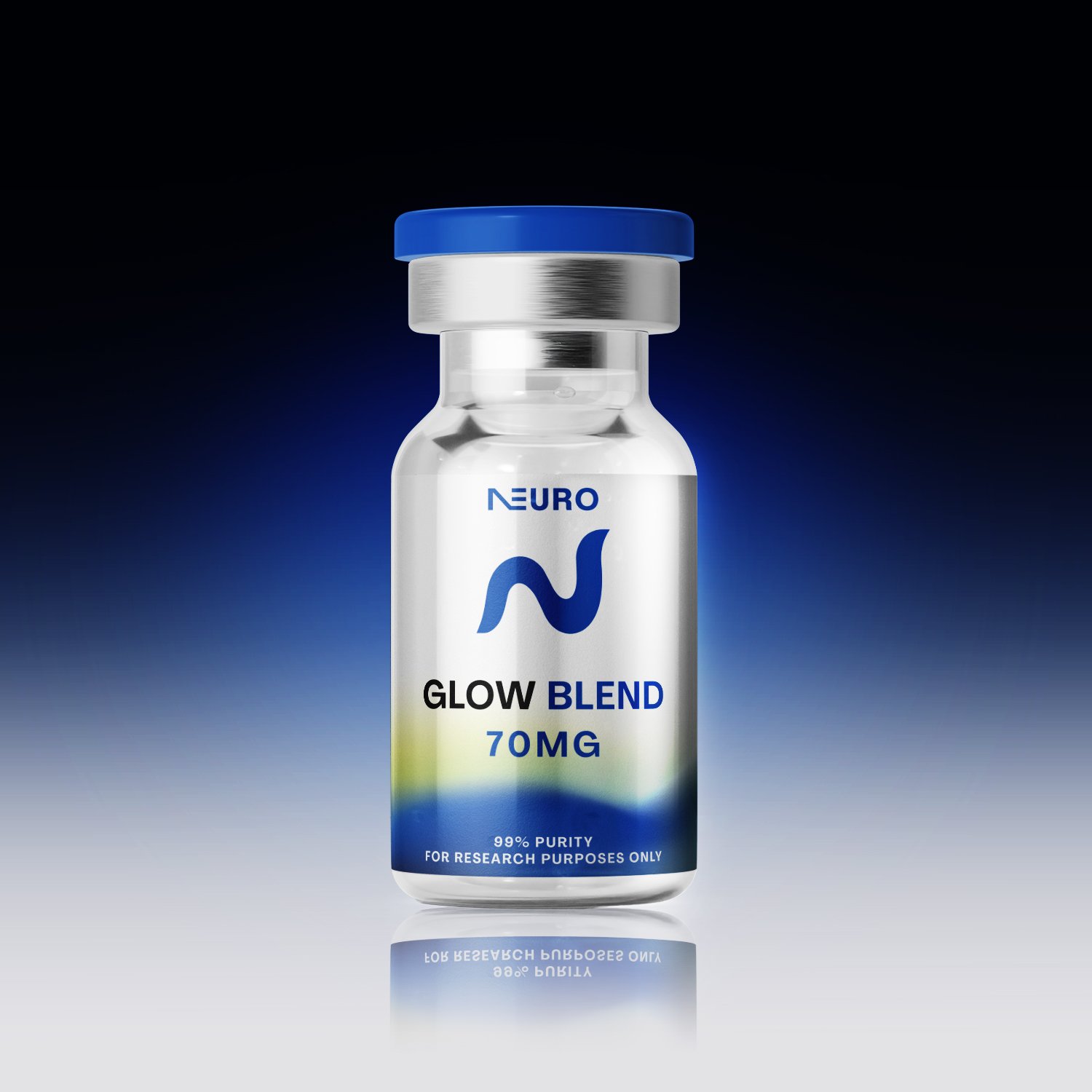
The GLOW Blend 70mg is an experimental blend comprising three distinct peptides, namely GHK-Cu, BPC-157, and TB-500. The blend is employed by researchers for examining tissue remodeling, angiogenic signaling, cellular migration, and regenerative gene expression within connective tissue, dermal tissue, and vascular tissue models (Pickart & Margolina, 2018; Goldstein et al., 2012).
Unlike other treatments that act via one biological pathway only, GLOW Blend involves a combination of different peptides that affect different but interrelated systems for tissue repair. Researchers’ interest in this treatment comes from the fact that the biological processes of tissue repair involve multiple factors, including the vascular system, structural factors, and cell signaling at the same time. It is vital to point out that this particular combination of three peptides has never been examined in any controlled trial as a single compound. (Sikiric et al., 2019; Pickart, 2008).
Regenerative biology studies today focus more on system-level experiments, where complementary signaling pathways are analyzed concurrently instead of separately. Tissue regeneration requires an integrated interaction of molecular processes, namely angiogenesis, collagen formation, inflammation resolution, and guided cellular migration, each of which influences tissue regeneration at its own level (Goldstein et al., 2012).
Researchers use multi-peptide formulations such as GLOW to explore how it is possible to study physiological interaction among tissue repair models when several mechanisms of action are combined into one formulation. Such an approach is still experimental, and no synergy of the peptides involved has been scientifically proven by means of comparative experiments (Chang et al., 2011; Hsieh et al., 2017).
Such an approach to experiments stems from the fact that the study of regenerative medicine and molecular biology today pays increasing attention to the comparison of treatments targeting one pathway only and formulations targeting multiple pathways at once. (Dubé & Smart, 2018).
GHK-Cu is a naturally occurring copper-containing tripeptide found in the blood plasma of humans. It was first identified by a biochemist named Loren Pickart. The plasma level of GHK-Cu falls sharply with age. A phenomenon correlated with the gradual slowing down of collagen metabolism and the healing of wounds that occur naturally with age. The role of GHK-Cu in the stimulation of collagen synthesis by fibroblasts in very low amounts (picomolar-nanomolar) and the regulation of matrix metalloproteinase expression involved in extracellular matrix remodeling have been investigated. Genetic analysis suggests that this peptide regulates the expression of many human genes involved in tissue repair and regeneration, but because GHK-Cu is widely formulated for topical delivery. Percutaneous absorption is limited. (Pickart & Margolina, 2018; Maquart et al., 1988).
BPC-157 is an artificial pentadecapeptide that was discovered within a protective peptide from human gastric juice. In preclinical studies, BPC-157 has been shown to increase the expression of VEGFR2 and induce the VEGFR2-Akt-eNOS signaling pathway in order to promote angiogenesis in tissues with limited vasculature, such as tendons and ligaments. In vitro studies have shown increased fibroblast migration, phosphorylation of focal adhesion kinase/paxillin, and collagen production after treatment with BPC-157, while animal experiments have shown fast recovery of tendons, muscles, and the gastrointestinal tract. All available data are based on animal models and in vitro tests, but there has been some concern among scientists about the possible upregulation of VEGFR2 in tumor tissue (Chang et al., 2011; Hsieh et al., 2017; Sikiric et al., 2019).
TB-500 is a synthetic peptide derived from the dominant active region of thymosin beta-4, which is a natural protein associated with cytoskeletal regulation. Through binding free monomeric G-actin, it has been suggested that TB-500 can promote the restructuring of actin filaments necessary for cell migration in wound healing, which would allow fibroblasts, keratinocytes, and endothelial cells to migrate effectively toward injury sites. Preclinical experiments have shown that thymosin beta-4 can accelerate wound closure, decrease the activity of inflammatory cytokines, and stimulate angiogenesis and endothelial progenitor cell mobilization. The extent to which findings from thymosin beta-4 apply to TB-500 remains uncertain and continues to be discussed. (Goldstein et al., 2012; Malinda et al., 1999; Sosne et al., 2010).
The suggested reason for the use of these three peptides would lie in their functional complementarity during different stages of tissue repair processes:
In combination, these processes should enable researchers to explore the vascular, structural, and migratory aspects of tissue regeneration using a unified model rather than studying the biological processes in isolation. Nonetheless, there is presently no peer-reviewed literature that supports the idea that such a combination of these three peptides creates additional effects other than those that can be observed independently for each of them separately (Dubé & Smart, 2018; Sikiric et al., 2019).
GLOW Blend constituents have individually been tested on models for the regeneration of soft tissue, especially soft tissues made up of connective tissues, blood vessels, and dermis after injury (Goldstein et al., 2012).
GHK-Cu is widely studied in dermatology for its part in the production of collagen and elastin, whereas BPC-157 and TB-500 are widely studied for their part in epithelial cell migration and matrix formation by fibroblasts in wound healing models (Pickart & Margolina, 2018; Maquart et al., 1988).
BPC-157 and TB-500 have been tested in laboratory settings regarding tendon, ligament, and muscle injuries, where BPC-157 and TB-500 have independently demonstrated their ability to promote rapid recovery, reorganization of collagen fibers, and improved biomechanical results in animal experiments (Chang et al., 2011; Sosne et al., 2010).
Since each of the peptides affects vascular signaling in a different way, researchers combine these peptides in order to observe angiogenesis and endothelial cells’ activity under the effect of several growth factors simultaneously (Hsieh et al., 2017; Dubé & Smart, 2018).
While there has been an increasing interest in using multiple peptide combinations, some limitations need to be noted:
It is used in laboratory research to study tissue repair, angiogenesis, and cellular signaling processes across connective, dermal, and vascular tissue models.
No. Evidence currently exists only for the individual peptides studied separately, not for the combined three-peptide formulation.
They are combined to allow researchers to study multiple complementary biological pathways, including collagen synthesis, angiogenesis, and cell migration, within a single experimental model.
No. It is intended strictly for research use only and is not approved by the FDA for human or animal therapeutic use.
The GLOW Blend 70 mg represents a triple-peptide formulation for research involving GHK-Cu, BPC-157, and TB-500, which have been independently researched for their individual functions within regenerative and reparative biology. The GHK-Cu is related to collagen production and signaling at the gene level, while the BPC-157 is related to angiogenesis and musculoskeletal repair, and the TB-500 is involved in cellular migration and actin filament regulation, which represent non-overlapping stages of the tissue repair process (Pickart & Margolina, 2018; Chang et al., 2011; Goldstein et al., 2012).
Although all three peptides have their own well-established history in preclinical research going back many decades, the three-peptide combination formulation does not have much research behind it and is not clinically validated or peer-reviewed yet. Further peptide research could provide valuable information regarding any benefits of using combinations over single-peptide research models, and any future research should take into consideration verified peptide purity information and well-defined endpoints (Sikiric et al., 2019; Dubé & Smart, 2018).
Certificate of Analysis
Storage guidelines
Like all other research peptides, Glow peptide is also sensitive to heat, light and improper handling. To maintain its stability and structural integrity throughout its use, it is important to understand the correct storage guidelines.
It is important to store the unopened vial in a refrigerator at 2°C to 8°C (36°F to 46°F) Maintaining a stable temperature is really important, and avoiding too many fluctuations. It is best to keep it in the main refrigerator compartment instead of placing it at the door. To protect the material from light exposure, it is important to keep the vial in its original packaging
Once the bottle is opened it is important to refrigerate it immediately at 2°C to 8°C (36°F to 46°F after each use. Avoid freezing, because with freezing, there is a risk that the peptide structure might get damaged due to ice crystal formation. Avoid shaking the vial, and gently swirl if mixing is required.
If you are traveling, keep the product in its original packaging for protection and stability. Also it is important to maintain temperature between 2°C to 8°C (36°F to 46°F) as consistently as possible. Use an insulated cooler or gel ice pack for travel longer than 30–60 minutes Avoid direct contact with ice to prevent accidental freezing Refrigerate immediately upon arrival For extended travel, plan ahead to ensure continuous cooling and minimal temperature exposure
Chemical properties